
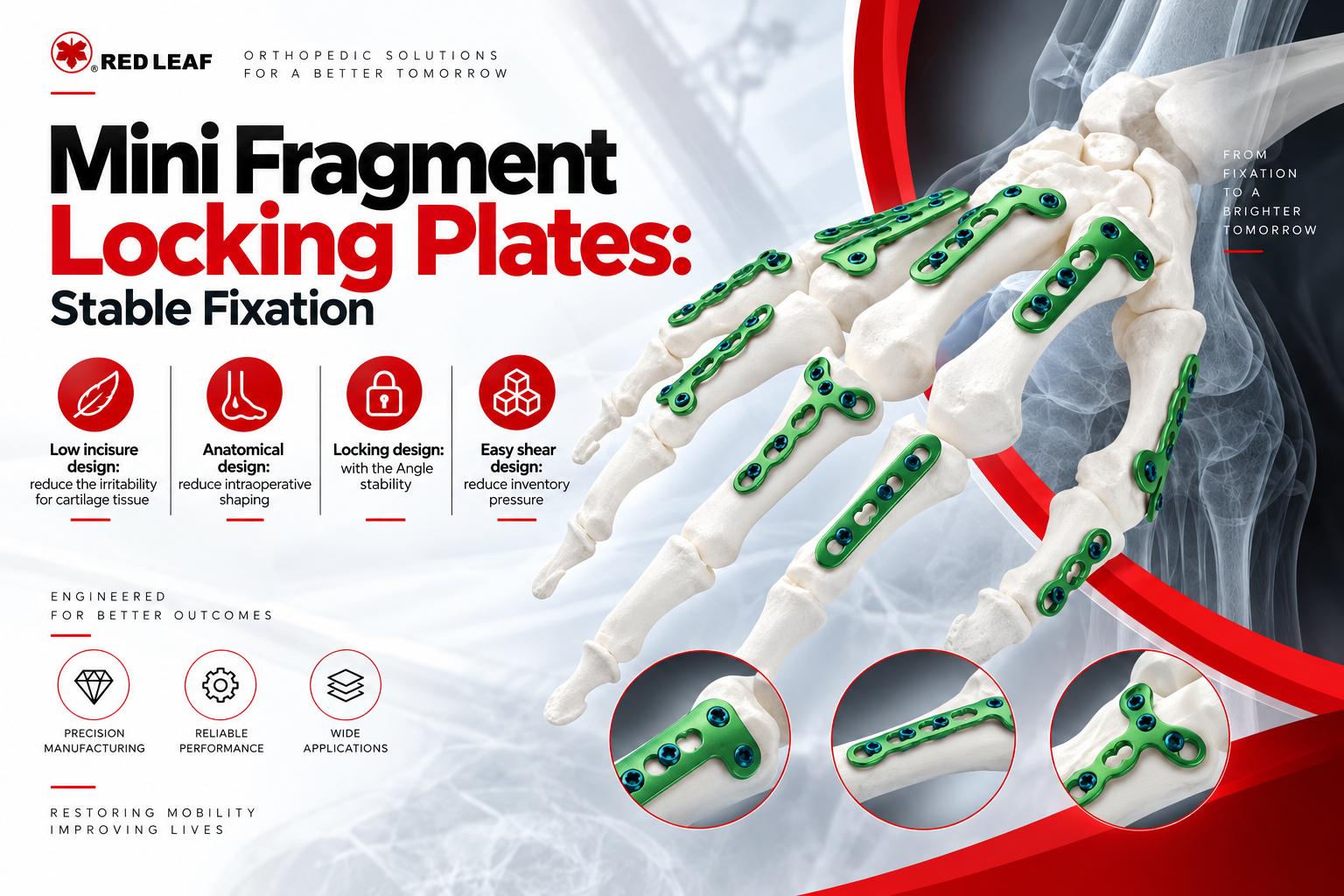
Mini fragment locking plates are designed for fracture fixation in small bones of the hand, wrist, foot and ankle. Because these bones are relatively small and often closely related to joint function, mini fragment plates are not simply smaller versions of standard Trauma plates. The plate design and fixation method need to be selected according to the patient’s fracture pattern and clinical condition. This article breaks down the different plate types, fixation principles, and instrument setups—so you can make a smarter buying decision. For importers and distributors, the complete system matters just as much as the individual plate. Plate type, size, screw compatibility, instrument configuration, and SKU requirements—together, they determine what a mini fragment product line is really worth.
What is Mini Fragment Locking Plates?
Mini fragment locking plates system are commonly used for fixation of small bones—typically in the hand, wrist, and ankle. Common sizes range from 2.0 mm to 2.7 mm range.That combination makes it better suited for fractures involving small bones or small bone fragments.
Stable fixation is especially important when treating small bones. There is less space for implant placement and screw positioning, so the plate profile, hole layout, screw diameter, and screw direction need to work together.When bone quality is poor, conventional screw fixation may not provide the same level of stability as a locking construct. This is where locking technology can offer an important advantage.
These locking plates rely on locking technology: the screw head engages with the threaded hole in the plate. The result is a fixed-angle construct that stays stable without depending on friction between the plate and bone. The Mini Fragment Locking Plates system combines stable fixation with the flexibility of dynamic compression and variable angle locking.
How to Choose Mini Fragment Locking Plates
There is no single mini fragment plate that fits every small-bone fracture. The available bone surface, fracture pattern, and required fixation direction can all affect the choice. Plate length, hole layout, screw diameter, plate profile, and whether the system is locking or non-locking also affect the decision.
Therefore, it is necessary to consider the product’s scope of coverage when making a purchase. A complete practical portfolio can meet your target market’s needs without accumulating excess SKU. For example, a market with a high volume of hand surgery may need more Straight, T-shaped, and L-shaped configurations. Foot&ankle orthopedics focused market may require a wider selection of periarticular and anatomically shaped plates.
The instrument set should also be checked at the same time. Drill guides, drill bits, taps, screwdrivers, and plate bending tools need to match the implant system. Otherwise, a broad plate portfolio may still be difficult for hospitals to use efficiently.
Types And Applications of Mini Fragment Locking Plates
REDLEAF is mini fragment locking plate system comes in a wide range of anatomical shapes, including Straight, T-shaped, L-shaped, Y-shaped, one-third tubular, H-shaped, and Hook Locking Plates. The available designs vary according to the intended anatomical application.
Plate Types | Clinical Scenario | Design Advantage | Reduction & Fixation |
Straight Plate | Metacarpal, phalangeal, and metatarsal fractures | Simple profile with different hole numbers and lengths | Helps maintain alignment after reduction and provides fixation along the bone |
| T-Plate | Distal radius, ankle, and other metaphyseal fractures | Wider T-shaped head provides additional fixation points | Helps support and stabilize smaller fracture fragments |
L-Plate | Fractures requiring a specific fixation direction | L-shaped profile supports directional fixation | Allows fixation from different planes when the fracture requires |
Y-Plate | Anatomical areas with a Y-shaped or branching structure | Multiple branches provide different screw directions | Screws can be distributed around separate fracture fragments |
| Condylar Plate | Periarticular and joint-related fractures | Designed to fit areas around the joint | Helps maintain the position of smaller fragments near the joint |
Reconstruction Plate | Irregular or complex anatomical areas | Can be cut and contoured to match the bone surface | Allows the plate to follow the anatomy after fracture reduction |
Mini Fragment Locking Plates Instrument Set
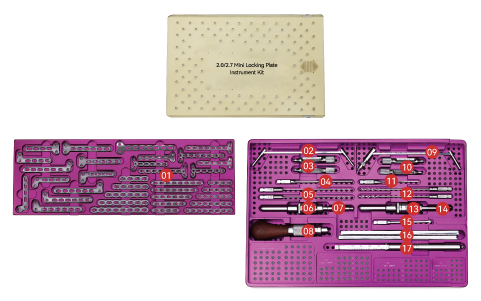
The Mini Fragment Instruments Set is one of the most required instruments to mend fractures in the bones of the hand, wrist, foot&ankle.The matching instrument set supports the steps required for fracture reduction, drilling, tapping, and screw insertion.
Mini Locking Plate Instrument Set includes a Tray, Guides, Drill Guides, Taps, Drill Bits, Screw Holding Devices, T6 and T8 Screwdrivers, a Straight Quick Handle, a Countersink Drill, a Plate Bending Wrench, and a Detector.
Some instruments are designed for specific screw or plate sizes. For example, the set includes a Φ2.0 Drill Guide and Drill Bit, as well as a Φ1.5 Drill Guide and Drill Bit. It also includes Φ2.7 and Φ2.0 Taps and T8 and T6 Screwdrivers.For importers and distributors, instrument compatibility is worth checking before placing a bulk order. A complete system should allow the plates, screws, and instruments to work together without requiring hospitals to source critical tools separately.
FAQ
What are the applications of mini-fragment locking plates?
Mini-fragment locking plates are primarily used for fracture fixation in small bones and peri-articular regions; common application sites include the hand, wrist, foot&ankle.
What Are the Advantages of Mini Fragment Locking Plates?
1.Low Incisure Design
Mini fragment locking plates are designed for smaller bones and limited anatomical space. Their compact profile can provide a better fit around small fracture sites.
2.Locking DesignStable Fixation
The locking mechanism connects the screw head with the threaded plate hole. This creates a fixed-angle construct and provides angular stability at the fracture site.
3.Suitable for Small Fracture Fragments
Small fracture fragments can leave limited space for screw placement. Different plate shapes, hole layouts, and screw options give surgeons more flexibility when planning fixation.
4.Wide Range of Applications
Mini fragment locking plates are commonly used in the hand, wrist, foot, and ankle. Different configurations can be selected according to the anatomical site and fracture pattern.
5.Flexible Fixation Options
A mini fragment system can combine locking and non-locking screws. Non-locking screws can provide compression, while locking screws offer angular stability. This gives surgeons more options for different fixation requirements.
What specifications are available for mini-fragment locking plates?
Specific specifications depend on the product series. REDLEAF’s micro locking plate system includes configurations such as 2.0 mm and 2.7 mm sizes, along with a matching instrument tray system.
Are Mini Fragment Locking Plates Suitable for Small Fracture Fragments?
Yes. Mini fragment locking plates are designed for fixation of small bones and small fracture fragments. However, the plate size, screw diameter, hole layout, and fixation points still need to match the bone anatomy and fracture pattern.
What Should Buyers Check in the Instrument Set?
Check whether the instrument set includes the basic tools required for the plate and screw system. Drill guides, drill bits, taps, screwdrivers, screw holding devices, and plate bending tools should all be compatible with the corresponding implants.
Complete Mini Fragment Locking Plates Solutions from REDLEAF
REDLEAF offers a Mini Fragment Locking Plate system and the related surgical instruments for small bone fracture cases—think metacarpal and phalangeal fractures in the hand, plus foot and ankle procedures. The current lineup covers a range of plate configurations and matching instrument solutions.
For distributors and importers, REDLEAF can support your orthopedic portfolio in several ways: product selection, specification confirmation, samples, technical documentation, and OEM/ODM support.